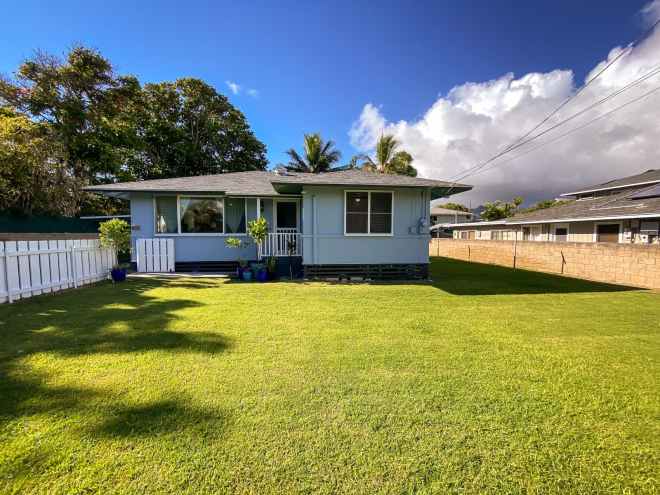
For millions of hardworking longtime Hawaii residents and the generations of Hawaiian’s growing up here in Hawai‘i, the dream was one day owning a piece of the ‘āina for your family to call Home. A modest house in Kalihi, a condo in Kona, or a small lot in Waimea or Wai‘anae was never easy to afford, but it felt possible with hard work and sacrifice, it seemed within reach. Today, that dream is dying.
In 2025, the median price of a single-family home on O‘ahu has surged past $1.1 million. On Maui, it’s $1.3 million. Even on the Big Island, long considered the “affordable” island, median home prices now exceed $650,000 and are rising faster than anywhere else in the state. Condos, once the fallback option for local families, now routinely sell for $700,000–$900,000 in urban Honolulu, and close to that in Kailua Kona. These aren’t just numbers. They are eviction notices written in today’s real-estate listings.
The Perfect Storm of Greed – Unchecked Corporate Investors and Luxury Development
Billionaires, hedge funds, and mainland developers treat Hawai‘i like a giant luxury resort portfolio. Entire new neighborhoods (Koa Ridge, Ho‘opili, Ward Village) are built with “market-rate” units priced for the global 1%. “Affordable” units in these projects, when they exist at all, are snatched up by investors or off-island buyers who easily meet the income caps because they have no rent or mortgage elsewhere.
Monster Homes and Short – Term Rentals
In older working-class neighborhoods from Kalihi to ‘Āina Haina, investors buy modest 3-bedroom homes, bulldoze them, and build 8–12 bedroom “monster homes” rented by the room to tourists on Airbnb. One house can generate $15,000–$25,000 a month—far more than any local family could ever pay in rent or mortgage. Entire streets have been converted into de facto illegal hotels, driving up land values and property taxes for the few local owners still holding on.
The Real-Estate Industry’s Greed-Driven Game
The local real-estate machine runs on one fuel: perpetual price escalation. Agents, brokerages, title companies, lenders, and appraisers all make more money the higher the sales price climbs. A $1.5 million sale generates roughly triple the commission and fees of a $500,000 sale. There is zero financial incentive for the industry to ever let prices cool. Many of the biggest players—Coldwell Banker, Locations, Hawai‘i Life, Compass—now openly court mainland and international investors with private “off-market” listings and “pocket listings” that never hit the public MLS. Local buyers literally never get a chance to bid. The industry calls this “relationship marketing.” Locals call it a rigged game.
Foreign Buyers
Despite the 2024 law banning most foreign purchases of residential property, loopholes remain wide open. Buyers simply form an LLC in Nevada or Delaware and purchase with cash. In 2024, over 42% of homes in Hawai’i sold entirely in cash to foreigners—something the vast majority of local families, even dual-income professional couples, cannot do.
Corporate Cash and the Institutional Land Grab
The newest and most ruthless player is corporate cash. Firms like Invitation Homes, American Homes 4 Rent, Progress Residential, and private-equity giants such as Blackstone and Pretium Partners have quietly purchased thousands of single-family homes and condos across the islands since 2021. They pay 20–40% over asking, all cash, 10-day close, no inspection, no appraisal contingency. No local family can compete with that. On Kaua‘i alone, institutional investors bought more than 1 in 4 homes sold in 2024. On O‘ahu’s Leeward coast, entire new developments in Kapolei and ‘Ewa are being sold in bulk to corporate buyers before ground is even broken. These companies then rent the homes back to locals at $4,500–$6,000 a month, forever.
Vacation Home Syndrome
The second- (or third-) home buyer from California, Washington, or Canada treats a $2 million beach house as an impulse purchase. They fly in twice a year, leave it empty the rest of the time, and still manage to outbid a local family that has saved for a decade.
The Political Failure
Lawmakers talk a good game. They pass resolutions “condemning speculative investment” and promise “bold action,” but the same politicians accept campaign donations from the developers and real-estate industry that profit from the crisis, and or own stake in these developments themselves. Bills to meaningfully tax vacant investment properties or close LLC loopholes die quietly in committee year after year.The 2019 “30% affordable” requirement for new developments has become a mockery—developers negotiate it down to 10–15%, and even those units are rarely affordable to families earning the actual Hawaii median income of roughly $92,000. Any meaningful solution to this would not be beneficial to our local politicians.
The End of Generational Land
Nothing cuts deeper than watching kama‘āina families lose the land their kūpuna held since the Great Māhele or earlier. Hawaiian homestead waitlists now stretch 30+ years. When a family member on leased fee-simple land passes away, the skyrocketing property-tax reassessment often forces survivors to sell just to pay the estate tax bill. The buyer? Almost always an investor or corporate entity with cash. In Waimānalo, Punalu‘u, and Hā‘ena, decades-old beachfront homesteads and kuleana parcels that stayed in the same Hawaiian family for 150 years are now owned by LLCs registered in Delaware. The family gets a check. The ‘āina gets another “No Trespassing” sign. Perhaps the most heartbreaking part is the quiet surrender.
The Perfect Storm of Greed
- Unchecked Investor and Luxury Development
- Monster Homes and Illegal Vacation Rentals
- Foreign Buyers Hiding Behind LLCs
- Second-Home Impulse Buyers
- Corporate Bulk Buyers Vacuuming Up Inventory
- A Real-Estate Industry Profiting From the Higher Prices Go
The Human Cost
Young families, construction workers, doctors, firefighters, and police officers are leaving in droves. Young Hawaiian families watch their parents’ homes get sold to BlackRock after the funeral because the children can’t afford the new $18,000-a-year property tax bill. Multi-generational households, once a cultural norm, are now an economic necessity. Young couples in their 30s and 40s still live with parents because renting a one-bedroom apartment now costs $2,800–$3,500 a month. Young locals have stopped talking about buying a home in Hawai‘i. They talk about when they will leave. Las Vegas, Portland, and Austin have booming Hawaii exile communities. Every mainland-bound flight on a Thursday or Friday carries another local family that finally gave up. This is not a housing shortage. There are more homes in Hawai‘i today than at any point in history. This is a greed crisis, orchestrated by an industry that profits from displacement, enabled by politicians who take their campaign checks, and accelerated by Wall Street balance sheets that see our islands as just another asset class. The culture, the language, the connection to ‘āina—everything that makes Hawai‘i more than just a pretty vacation postcard—is being hollowed out one escrow closing at a time. Until Hawai‘i’s elites decide its people are worth more than the next all-cash offer from a hedge fund, the local homebuyer—and the culture itself—will remain an endangered species in the only place we can truly call home.
This dream isn’t vanishing.
It’s already been sold.
Discover more from South Pacific Concrete & Masonry LLC
Subscribe to get the latest posts sent to your email.
